

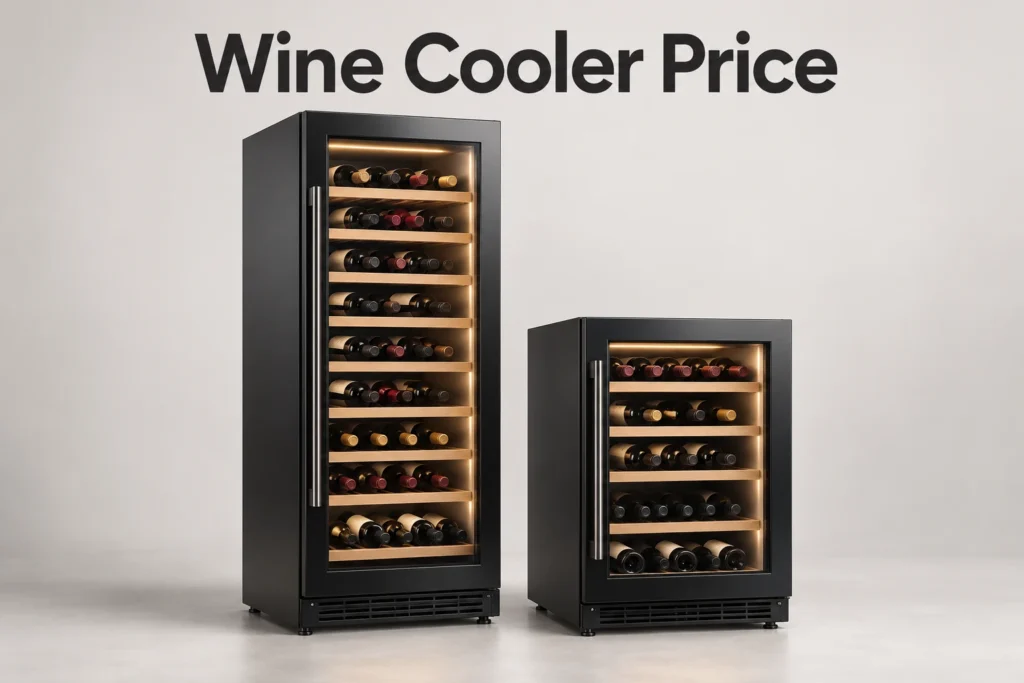
Wine Cooler Price Guide: How Much Should You Actually Spend?
Most people buying their first wine cooler make the same mistake: they either spend too little and end up with a noisy, unreliable unit that can’t hold temperature, or they overspend on features they’ll never use. The wine cooler market spans a surprisingly wide range — from $150 compact countertop units to $5,000+ built-in cellar appliances — and the right price point depends almost entirely on how you plan to use it.
This guide breaks down what you actually get at each price tier, which features are worth paying for, and where most buyers leave money on the table.
Wine Cooler Price Ranges at a Glance
| Price Range | Capacity | Typical Features | Best For |
|---|---|---|---|
| $100–$250 | 6–24 bottles | Single zone, thermoelectric, basic digital display | Occasional wine drinkers, small apartments |
| $250–$600 | 24–50 bottles | Single or dual zone, compressor, wooden shelves, UV glass | Regular wine drinkers, starter collections |
| $600–$1,500 | 50–100 bottles | Dual zone, compressor, humidity control, carbon filter | Serious enthusiasts, medium collections |
| $1,500–$4,000 | 100–200 bottles | Active humidity, vibration isolation, built-in options, premium brands | Collectors, long-term aging |
| $4,000+ | 150–400+ bottles | Full climate control, sommelier-grade specs, designer cabinetry | Premium collections, wine rooms |
What Actually Drives the Price Up?
Before comparing specific models, it helps to understand which features actually cost money — and which are just marketing.
Compressor vs. Thermoelectric Cooling
This single choice affects both the price and the performance more than almost any other factor.
- Thermoelectric coolers ($100–$400 range) are quieter and vibration-free but can only cool 20–25°F below ambient temperature. In a room warmer than 75°F, they struggle.
- Compressor-based coolers work in any ambient temperature, cool faster, and are far more reliable for long-term storage. They cost more but dominate the mid-to-high tier for good reason.
If you live somewhere warm or plan to store wine for more than a year, don’t even look at thermoelectric units.
Single Zone vs. Dual Zone
A dual-zone cooler maintains two separate temperature compartments — typically one for reds (55–65°F) and one for whites and sparkling (45–55°F). Expect to pay a $100–$200 premium over an equivalent single-zone model.
Worth it if: you regularly serve both reds and whites and want them at the right temperature without thinking about it.
Not worth it if: you mostly drink one type, or you’re happy pulling bottles out 20–30 minutes before serving.
Humidity Control
This is often the most underrated feature. Passive humidity (just a sealed environment) keeps corks from drying out for 2–3 years. Active humidity control — found in units above $1,200 — maintains 60–70% relative humidity consistently, which matters for collections you plan to age 5+ years.
Vibration Isolation
Vibration disturbs sediment and disrupts the slow chemical processes that improve wine over time. Budget units sit on the same compressor vibration as a standard refrigerator. Premium units use dedicated compressors with dampened mounts. If you’re aging fine Bordeaux or Barolo past 10 years, this matters. For everyday drinking wines, it doesn’t.
Brand Comparison: What You Pay For
| Brand | Price Tier | Strengths | Trade-offs |
|---|---|---|---|
| Ivation / Kalamera | Budget ($100–$300) | Low entry cost, decent for short-term storage | Thermoelectric, inconsistent QC, limited warranty |
| Whynter / Avallon | Mid ($300–$800) | Reliable compressors, good capacity-to-price ratio | Bulky, not built-in compatible |
| Electrolux | Mid-premium ($600–$1,500) | Built-in compatible, clean design, Cellar Pro 5 system | Limited zone options in mid range |
| Dunavox | Mid-premium ($700–$2,000) | Wide capacity range, dual-zone variety, good humidity | Less brand recognition in North America |
| Liebherr | Premium ($1,500–$4,000) | German engineering, active humidity, long-term reliability | High upfront cost |
| Gaggenau | Ultra-premium ($3,000+) | Collector-grade climate control, seamless kitchen integration | Price makes sense only for serious collections |
For a deeper look at how these brands compare by model — including capacity specs, energy ratings, and installation requirements — the team at wine cooler has put together one of the more thorough independent comparisons available.
Hidden Costs Most Buyers Overlook
Installation
Freestanding units just need a power outlet and clearance for ventilation — typically 3–4 inches on all sides. Built-in units require front ventilation and precise cabinetry measurements. If you’re retrofitting a kitchen, that cabinetry work can add $300–$800 to the real cost.
Electricity
A mid-size wine cooler running 24/7 adds roughly $50–$120 per year to your electricity bill depending on energy class and ambient temperature. An A-rated unit saves 40–60 kWh annually versus older G-class models. Over 10 years, that’s a meaningful difference.
Under-buying on Capacity
Wine collections tend to grow. The single most consistent complaint from wine cooler owners isn’t the brand or the noise level — it’s buying too small. If you think you need 30 bottles, buy 50. If you think you need 50, buy 75. The price difference between adjacent capacity tiers is usually $100–$200; running out of space and buying a second unit costs far more.
Do You Actually Need a Wine Cooler?
Not everyone does. Here’s an honest breakdown:
You probably don’t need one if:
- You buy and drink wine within a few weeks
- Your bottles cost under $20 each
- You have a cool, dark basement or cellar (55°F, stable humidity)
- You drink fewer than 2 bottles per week
A wine cooler makes clear sense if:
- You’re buying bottles to age for 2+ years
- You’re spending $40+ per bottle regularly
- Your home runs warm (above 70°F consistently)
- You want to serve wine at the correct temperature without planning ahead
- You’re building a collection of 30+ bottles
5 Mistakes to Avoid When Buying
- Choosing thermoelectric in a warm climate. A unit that can only cool to 20°F below ambient is useless in a garage or non-air-conditioned room in summer.
- Ignoring the energy rating. The cheapest unit often costs the most over time.
- Buying single zone for a mixed collection. If you drink both reds and whites, dual zone is worth the premium.
- Skipping the humidity question. Passable for short-term; active control for aging. Confusing the two leads to dried-out corks years later.
- Measuring wrong for built-in installation. Built-in units need precise niche dimensions. Measure twice, including door swing clearance and ventilation space.
Quick Buying Checklist
- ☑ How many bottles do I need to store now, and realistically in 3 years?
- ☑ Single zone or dual zone?
- ☑ Freestanding or built-in?
- ☑ What is the average room temperature where the unit will be placed?
- ☑ How long will I age the bottles? (Under 2 years = passive humidity fine; over 5 years = active humidity preferred)
- ☑ What is the noise tolerance? (Bedroom/living room = aim for under 38 dB)
- ☑ Is energy class A or above?
- ☑ What warranty and local service options exist?
The Bottom Line
For most buyers, the $400–$800 compressor-based dual-zone range hits the best balance of features, reliability, and price. Below that, you’re making compromises on cooling performance that matter more than the savings suggest. Above $1,500, you’re paying for aging-grade specifications that only make sense if you’re storing serious bottles for serious time.
The most important thing isn’t hitting a specific price — it’s matching the unit to how you actually use wine. A $300 cooler that fits your collection and your habits beats a $1,200 unit with features you’ll never use.
Konu Başlıkları
